
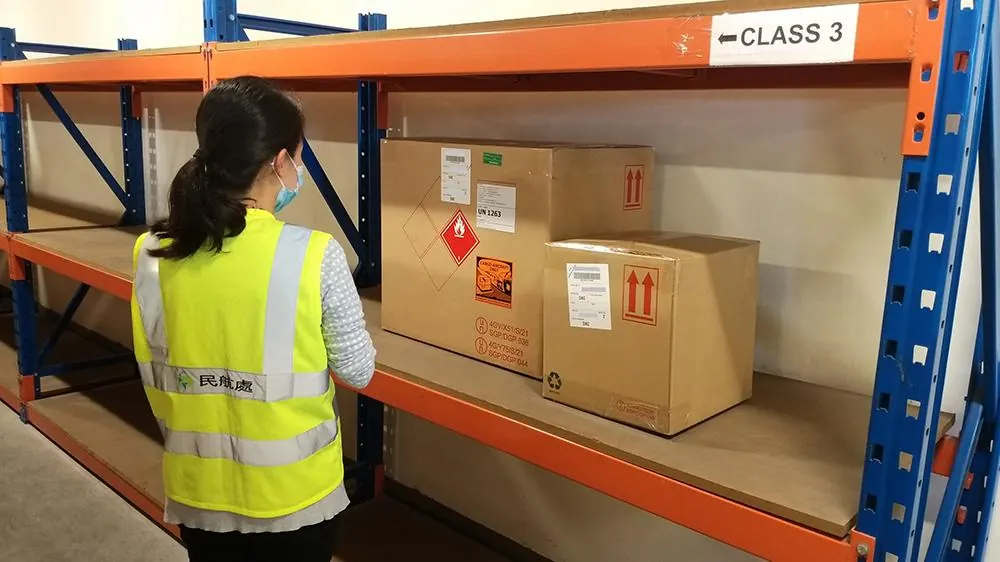
Transporting dangerous goods by air, or Dangerous Goods Air Freight, requires checks beyond weight and volume. Certain products' chemical, physical or safety characteristics require classification, packaging, markings and documents to be established before booking.
Some batteries, chemicals, gases, paints, aerosols and flammable liquids may be regulated as dangerous goods. Whether a product is industrial or everyday does not, by itself, determine its air-transport classification.
How are dangerous goods identified?
Start with precise product specifications and manufacturer information. The shipper is responsible for correct classification; unclear cases require help from the manufacturer, an accredited laboratory or a competent authority. A trade name alone is insufficient.
- UN Number: the applicable identification number, where assigned;
- Proper Shipping Name: the correct transport name;
- Hazard class or division and packing group, where applicable;
- Quantity per package and package count;
- Physical state, composition and relevant technical information.
How does an SDS help?
For chemicals, a safety data sheet, or SDS, can help establish the product's characteristics. It does not replace correct transport classification; its transport information must be checked against the product and applicable rules.
An SDS should not be treated as an identical, universal requirement for every product, including all batteries and equipment. Required documents depend on the goods and acceptance conditions.
Main requirements before air shipment
- Classification: Identify the goods and relevant restrictions accurately;
- Packaging: Select packaging that complies with the applicable packing instruction;
- Marking and labelling: Apply the marks and labels required for the specific shipment;
- Documents: Prepare the necessary documents and shipper's declaration where required;
- Route acceptance: Check country, airport and airline restrictions along the route;
- Confirmation before booking: Establish acceptance feasibility and the service scope.
This article explains the assessment process. Qualified personnel must determine final packaging, permitted quantities and documentation using the rules applicable at dispatch.
Can dangerous goods travel on passenger aircraft?
Some goods and quantities may travel on passenger aircraft under specified conditions; others are restricted to cargo aircraft or prohibited. The phrase Cargo Aircraft Only indicates a cargo-aircraft restriction, not blanket permission to transport any product.
Do all airlines accept dangerous goods?
No. Acceptance depends on the goods and quantity, packaging, route and airline restrictions. Compliance with baseline rules does not oblige every airline to accept a shipment. Obtain acceptance for the specific service before physically dispatching the goods.
What affects dangerous-goods air freight costs?
Commodity, hazard class, chargeable weight, packaging, route and airline affect the rate. Document checks, handling and special operations may add charges. Compare quotes with a clear service scope and delivery point.
Where should you start if the product contains batteries?
Identify the battery type and whether it is standalone, packed with equipment or installed. Details appear in the lithium-battery air freight guide . For large equipment, heavy air cargo restrictions also require a separate assessment.
Request a dangerous-goods freight assessment
Send an accurate commodity description, available technical documents, UN number if known, quantity per package, weights and dimensions, origin, destination and ready date. Nikco Logistics assesses acceptance and feasible routes. For the general service scope, see our international air freight page.
Source and regulatory review
General guidance in this article was reviewed against IATA's official dangerous-goods guidance; sources reviewed on 26 October 2026. The applicable edition and airline restrictions must be checked again at dispatch.