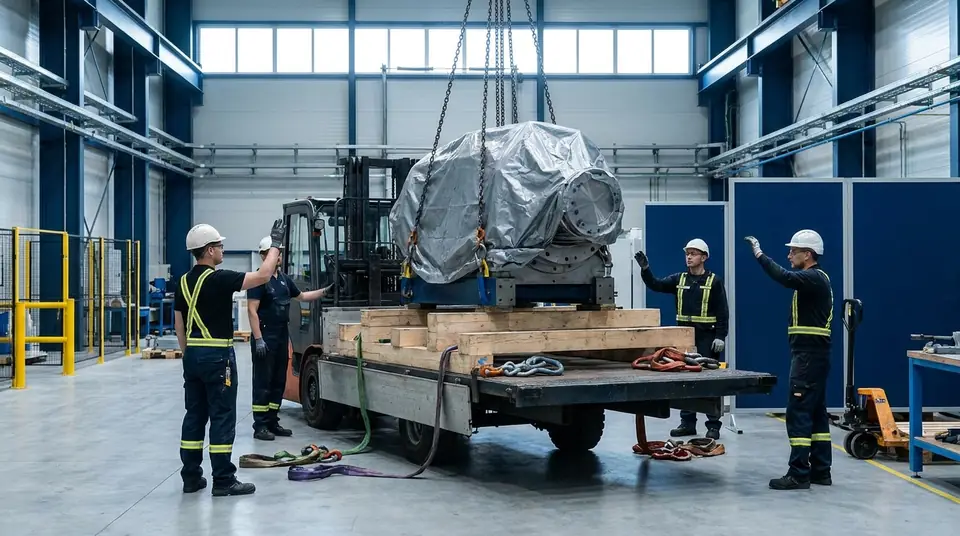
Industrial logistics starts with understanding the cargo.
The industry name alone does not determine the transport mode. Weight and dimensions, packaging, equipment sensitivity, project location, loading and unloading conditions, and the required schedule shape the actual transport plan.
The transport plan starts with the equipment's actual specifications.
Industries We Serve / 02
Every industry has a different transport profile.
Select an industry to review its common cargo, key transport challenges, and related services.
OIL, GAS & PETROCHEMICAL
Oil, Gas & Petrochemicals
From a small urgent part to heavy, sensitive, and oversized project equipment.
Common Cargo
Pumps & Compressors
Industrial Valves
Piping Equipment
Pipes & Fittings
Process Skids
Refinery Tanks
Electrical & Instrumentation Equipment
Spare Parts
What is the transport challenge?
Delivery sequence, project location, site-access restrictions, technical documents, and dangerous-goods regulations can all affect the plan. Oversized equipment requires route and specialized-equipment assessment, while a critical maintenance part may need to move by air because of its deadline.
MINING & METALS
Mining & Metals
High weight is only part of the challenge; load distribution, site access, and destination operations are equally decisive.
Cargo We Assess
Mining Machinery
Crushing Equipment
Mills & Components
Production-Line Equipment
Heavy Components
Sheet & Profiles
Minerals
Site Spare Parts
What is the transport challenge?
Weight, dimensions, and load distribution must be assessed together with the site-access route, unloading equipment, ground conditions, maneuvering space, and final delivery point. For minerals and metal products, shipment volume and access to rail, road, or port networks also affect the right transport mode.
POWER & ENERGY
Power & Energy
Some equipment cannot be defined by weight alone; sensitivity during movement is also part of the plan.
Common Cargo
Transformers
Generators
Turbines & Components
Power-Plant Equipment
Electrical Panels & Equipment
Solar Equipment
Energy Infrastructure
Spare Parts
What is the transport challenge?
The center of gravity, lifting points, and tilt limitations must be defined before transport equipment is selected. Heavy cargo requires checks on bridges, clearances, width, turning radius, and access to the unloading location; for an urgent part, time may matter more than cost.
MACHINERY & PRODUCTION LINES
Machinery & Production Lines
From a single machine to hundreds of packages and components for a complete production line.
Common Cargo
Production Machinery
Packaging Lines
Factory Equipment
CNC Machines
Pumps & Motors
Industrial Automation
Molds & Tooling
Complete Production Lines
What is the transport challenge?
Standard equipment may move by regular road, ocean, or air freight, while non-standard cargo enters the scope of project logistics. In a multi-supplier project, pickup, consolidation, grouping by installation sequence, and phased delivery are as important as the transport mode.
Type of Requirement / 03
Projects and daily operations have different logistics requirements.
An industrial company may be managing two entirely different shipment profiles at the same time.
PROJECT / 01
Project Cargo
For the construction, expansion, or installation of a new unit. It usually involves larger equipment, multiple suppliers, and delivery milestones tied to the project schedule.
OPERATIONS / 02
Operational Parts & Supplies
For an operating site. A small part may be more critical than a multi-ton load because any delay can interrupt operations.
Selection Guide / 04
Which service fits which requirement?
This comparison is a starting point; the final choice depends on the actual cargo and route.
0109
Cargo RequirementHeavy or oversized cargoService to AssessProject LogisticsCargo RequirementUrgent partService to AssessAir FreightCargo RequirementStandard machineryService to AssessRoad or Ocean FreightCargo RequirementHigh volumeService to AssessOcean or Rail FreightCargo RequirementMultiple suppliersService to AssessWarehousing & ConsolidationCargo RequirementDirect regional deliveryService to AssessRoad FreightCargo RequirementNo single mode covers the full routeService to AssessMultimodal TransportCargo RequirementPre-shipment storage and preparationService to AssessWarehousing & Value-Added ServicesCargo RequirementMovement under a transit procedureService to AssessTransit Services
Option 1 of 9
Enquiry Information / 05
“Industrial machinery” is not enough for an accurate assessment.
The more precise the cargo details, the more accurately the vehicle, route, and handling equipment can be selected.
01
Equipment Description
The equipment name, purpose, and actual cargo type.
02
Quantity
The number of machines, packages, or project components.
03
Weight & Dimensions
The specifications of each main piece and the total weight.
04
Packaging
Pallet, crate, skid, container, or unpackaged cargo.
05
Drawing or Photo
Especially useful for large and non-standard equipment.
06
Center of Gravity & Lifting Points
Required for equipment selection and safe handling.
07
Origin & Destination
The actual pickup location and final delivery point.
08
Project Schedule
The cargo-ready date and required date at the site.
09
Site Conditions
Entrance, maneuvering space, crane availability, unloading restrictions, and the exact delivery point inside the site.
Send the cargo type, quantity, weight, dimensions, origin, destination, and required timing. For large equipment, technical drawings and photographs also support the initial assessment.