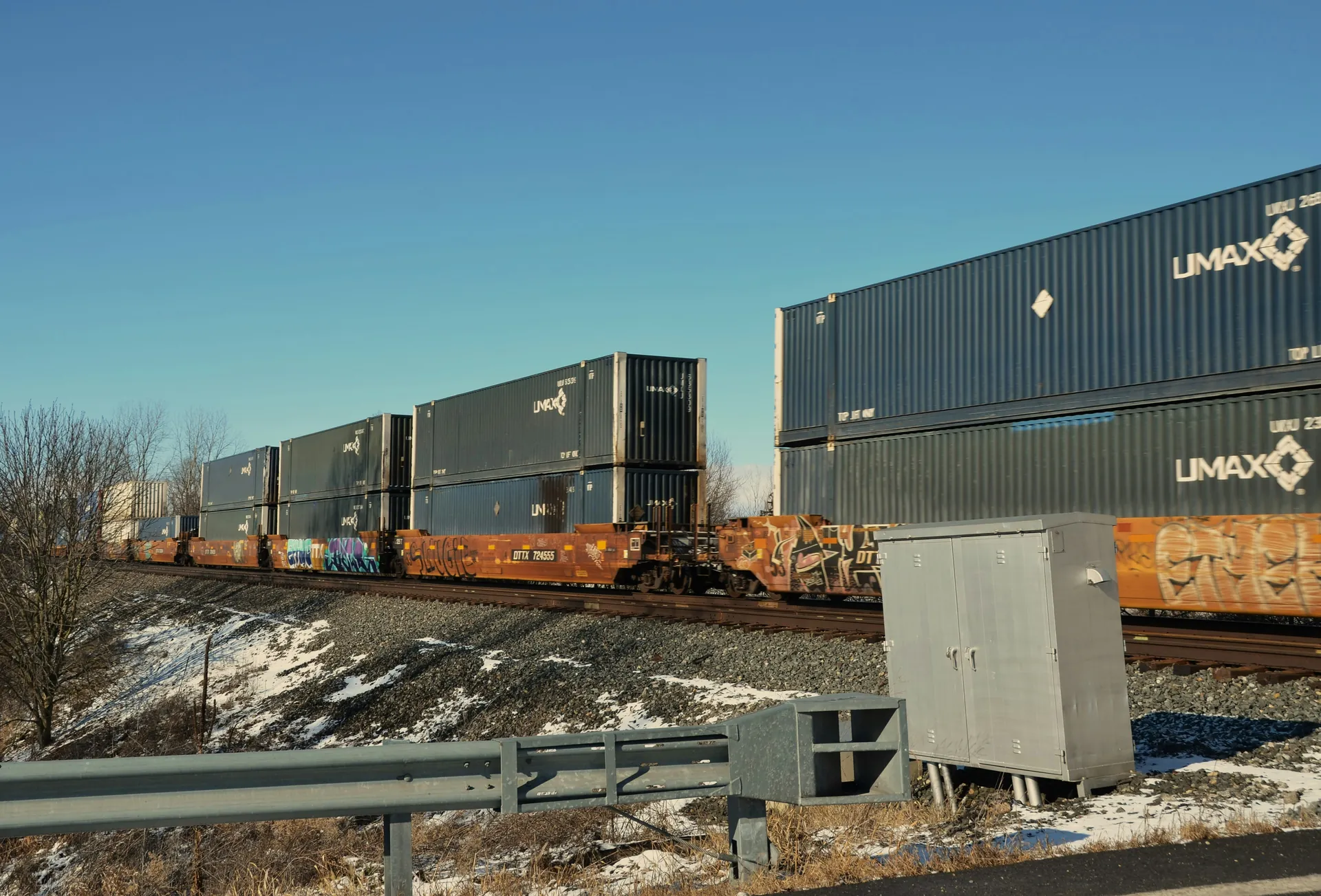
Central Asian corridorContainers and rail equipmentImports and exports
RAIL FREIGHT
Direction of transportIran ↔ China
Cargo typecommercial and industrial
EquipmentContainer or wagon
Service scheduleChecked at enquiry
Decision of the route
Is rail transportation suitable for your cargo?
Rail can complement sea and road freight for some commercial and industrial cargo between Iran and China. The decision depends on more than the train's journey time.
Origin and destination cities, weight and volume, commodity, distance to the terminal, equipment requirements, service capacity and border handling must be assessed together. NIKCO.LOG Assess time and cost from loading point to final destination .
Before assessing route and rate, establish whether the goods can be accepted on the service or require further approval.
Acceptance depends on commodity, packaging and route restrictions. Some shipments can be assessed from standard details; others require specific approval before planning.
Usually possible to assess
Machinery and production lines
Industrial, electrical and electronic parts and equipment
Raw materials
Metal and mineral products
Containerised cargo
Some heavy and bulk cargo
Requires confirmation before acceptance
Battery and battery-containing goods
Chemicals and dangerous goods
Food, pharmaceuticals and medical equipment
Oversized or super heavy cargo
Export-controlled cargo
Temperature sensitive equipment
Route and borders
What is the Iran–China rail route?
The map uses the Qom–Yiwu train as a real example, showing its origin and gateways. The guide below follows the border crossings and rail-network changes; your shipment may use different endpoints.
Historical example · 2024From Qom to Yiwu, via Central Asia
Points show cities and gateways. The solid line indicates corridor sequence and the dashed line shows inland China connections schematically, rather than exact railway alignment.Geography: Natural Earth · Source for the Qom–Yiwu route
Arrangement of crossingIran, Turkmenistan, Kazakhstan, China
01Iran1,435 mm network
Border 1What's out / EtrakIran and TurkmenistanGauge change: 1,435 to 1,520 mm
02Turkmenistan1,520 mm network
Border 2Serhetyaka / BolashakTurkmenistan and KazakhstanTransit on the 1,520 mm network
03Kazakhstan1,520 mm network
Border 3Altynkol / KhorgosKazakhstan and ChinaGauge change: 1,520 to 1,435 mm
04ChinaContinuing in China's domestic network
Actual origin and destination
Where does the cargo leave and where will it be delivered?
The Qom–Yiwu example does not fix every shipment's origin or destination. Factory or warehouse location determines the suitable terminal; a city's rail connection does not necessarily mean a direct scheduled train to China.
In Iran
Loading in Iran
Aprin dry port near Tehran is an important Iranian international rail hub. Depending on cargo location, equipment and departures, shipments may enter the network at another station or first move to a main hub.
Qom
Isfahan
Yazd
Mashhad
Tabriz
Bandar Abbas
The use of each city is subject to checking the service and operational efficiency of the same cargo.
In China
Loading and delivery in China
For imports, cargo can move from its origin city or factory to a Chinese rail hub. For exports to China, the route continues beyond Khorgos to the destination city or warehouse. Xi'an is an important international freight rail hub, but routes are not limited to this city.
Xi'an
Yiwu
Shanghai
Shenzhen
Guangzhou
Ningbo
To calculate the time and rate, the exact name of the destination city, warehouse or factory is required.
Select equipment
Container or wagon: which suits the cargo?
Once both ends of the route are known, weight, dimensions and packaging determine whether containerised or wagonload transport is more suitable.
A
Container transportation
For industrial parts, machinery, raw materials and packed goods. At gauge changes, containers are usually transferred between wagons on the two networks while cargo remains inside.
Full container load
Consolidated service, subject to available capacity
Less handling of the cargo itself
B
Carriage by wagon
May suit metal products, minerals, raw materials, heavy cargo and certain bulk goods. Wagon selection depends on weight, dimensions and loading and unloading methods.
Wagon matched to cargo type
Checking route network restrictions
Confirmation of transfer method before loading
Technical point on the route
What happens to the cargo at the borders?
Container or wagon selection affects border handling. Iran and China use 1,435 mm gauge, while Turkmenistan and Kazakhstan mainly use 1,520 mm. Transfers into the next network must therefore be coordinated at the Iran–Turkmenistan and Kazakhstan–China borders.
For containerised freight, the container is usually transferred to a wagon on the next network while the cargo stays inside. For wagonload freight, terminal facilities determine whether bogies can be exchanged or cargo must be transferred to another wagon. The method is agreed before loading.
Iran1435mm
←
Central Asia1520mm
←
China1435mm
Time and cost
How long does transport take and what does it cost?
Routing, equipment and border handling all affect time and cost. Compare options from loading to final delivery; no single rate or lead time applies to all shipments.
What affects lead time?
Train movement and formation schedule
Available capacity on the shipping date
Border handling and gauge changes
Customs formalities
Inland transport in Iran and China
What determines the rate?
Loading city and final destination
Weight, volume and dimensions
Commodity and equipment
Terminal and border charges
Insurance, customs and final delivery
Shipment execution
From cargo inspection to final delivery
After agreeing the route, equipment, schedule and rate, booking and execution follow. Documents, loading, border handling and delivery are coordinated with the cargo owner.
01Consignment definition
Origin, destination, commodity, weight, volume and cargo ready date.
02Route planning
Choosing the station, hub and initial and final shipping method.
03Confirmation of service
Inspection of capacity, equipment, Borders and restrictions of goods.
04Execution coordination
Booking, documents, loading, export formalities and border coordination.
05Entry into the destination network
Destination formalities, continuation of domestic transportation and delivery within the agreed range.
Before you enquire
Answers to common questions
Does the cargo have to be sent from Tehran? +
No. The suitable rail entry point depends on cargo location, equipment, schedules and initial transfer costs. A city's rail connection does not mean a permanent direct train to China.
What is the minimum acceptance volume? +
Commercial shipments from 1 CBM are considered. Consolidated freight depends on an active service, available capacity and cargo type.
How long does rail freight to China take? +
Lead time is not fixed. Origin, destination, departure date, train assembly, border operations, customs and inland transport in China all affect door-to-door timing.
Does the delivery take place in the final city of China? +
Where feasible, cargo can continue beyond Khorgos by Chinese domestic rail or road to the agreed destination. State the precise destination city at enquiry.
Is rail or sea freight the better option? +
The answer depends on the shipment and both ends of the route. Compare total rail cost and lead time with sea freight to select a feasible option.
Rail-freight enquiry
From your cargo details to a freight plan.
Send origin and destination cities, commodity, package weight and dimensions, and cargo ready date so route, lead time and cost can be assessed.