Sohar and other Omani ports, or Karachi and Port Qasim in Pakistan, can be assessed for freight from China and other origins to Iran. The key difference is the last leg: mainly onward sea freight from Oman, while Pakistan allows comparison of sea freight and road transit.
Option 01 / OmanOverseas origin → Sohar → IranMainline vessel, intermediate hub, then feeder subject to service confirmation
Option 02 / PakistanOverseas origin → Karachi → IranSelection between sea feeder and land transit
01 / Before choosing a port
Arrival at the hub is only one stage
In past years Jebel Ali was a familiar hub for many Iran-bound shipments: cargo arrived on a mainline vessel and continued on a regional service. When a hub or onward sea service is unreliable, Sohar and Karachi are alternatives to compare; no port alone guarantees onward transport to Iran.
For each shipment, two separate questions must be answered: Which shipping line carries the cargo to the hub? and Which onward carrier and equipment will take the cargo from the hub to Iran, with acceptance of the commodity, container and destination? A sea-freight rate only to the hub does not answer the second question.
Time-sensitive information
The source text's references to regional operational restrictions and shipping schedules relate to September 2026. Port, strait, feeder and shipping-line conditions must be checked again when obtaining a rate and before booking.
Route overview
Three ways to continue from the hub to Iran
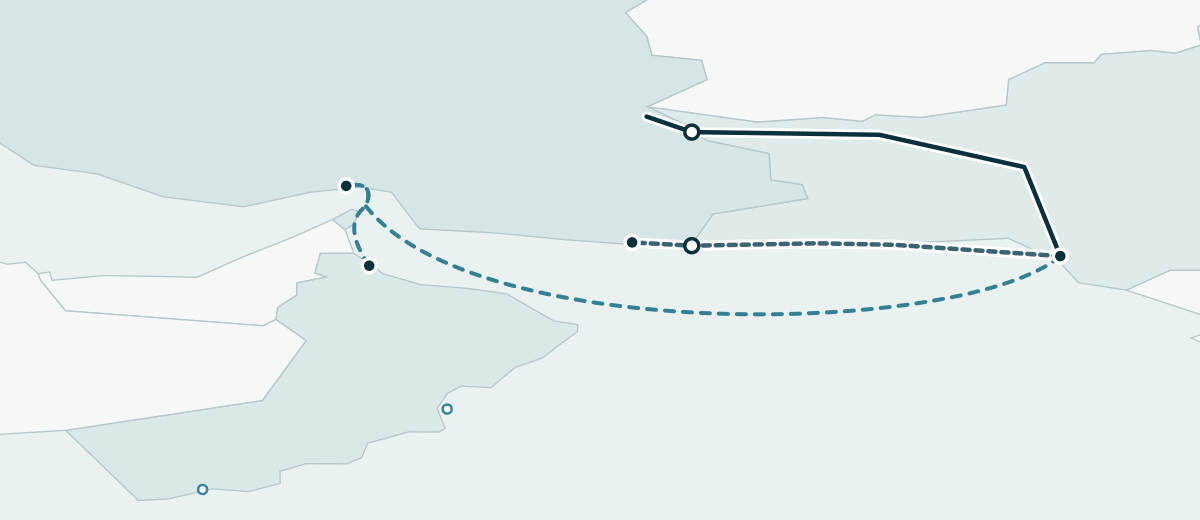
This map locates Sohar and Karachi in the region. Blue dashed lines indicate sea legs; dark lines indicate road legs. Route selection depends on the service, container acceptance and permits for the shipment.
NIKCO.LOG / OMAN · PAKISTAN · IRAN
Freight routes into Iran
Sea freight, intermediate hubs and two road corridors through Pakistan
To see the entire map, drag it left and right.
IranOmanPakistanSoharOman hubSalalahDuqmBandar AbbasExample sea destinationChabaharKarachi / Port QasimPakistan hubTaftan / MirjavehNorthern border crossingGabd / RimdanCoastal border crossingStrait of Hormuz
Sea leg to assessRoad leg to assess
01Sohar → Bandar Abbassea continuation; Dependent on Feeder and acceptance of equipment
02Karachi → Bandar AbbasSea continuation; depending on the connection and the sea route
03Karachi → Iranian borderOnward road freight via Taftan–Mirjaveh or Gabd–Rimdan
For Oman, first select a port suitable for the sea service and cargo, then check container acceptance and onward connection to Iran.
Main hub to assess
Sohar SOHAR
Sohar in northern Oman connects to Asian shipping networks. For container freight from China, a possible arrangement is a mainline vessel to Sohar followed by a feeder to Bandar Abbas, subject to service availability and cargo and equipment acceptance.
CHINA → SOHAR → BANDAR ABBAS
If the container owner allows the same equipment to continue to Iran, unloading the goods at Sohar is unnecessary. Feeder availability alone does not mean the mainline container may enter Iran; confirm this before booking.
Service-dependent option
Salalah SALALAH
Salalah is a major southern Omani hub on east–west routes, but is farther from Iran than Sohar. It is worth comparing when the origin mainline service is better suited to Salalah or Sohar's connections and space are less suitable.
Special cargo
Duqm DUQM
Duqm lies on the Arabian Sea outside the Strait of Hormuz. It can be considered for bulk, breakbulk, RoRo, machinery and project cargo, but should not be treated as an automatic alternative to Sohar for a regular China–Iran container service.
When the mainline container cannot continue to Iran
1 / Transfer at Sohar
Cargo arrives in Sohar in a carrier-owned container (COC) and is transferred at an authorised facility into an SOC or equipment accepted by the next operator. The original container remains in Oman; cross-stuffing adds cost and handling.
COC → SOHAR → CROSS STUFFING → SOC / FEEDER
2 / SOC from origin
If a suitable SOC is available in China and accepted by every carrier on the route, the same container may continue to Iran without unloading the goods at Sohar. Reduced handling can be valuable for machinery and sensitive cargo.
SOC → SOHAR → FEEDER → IRAN
03 / Pakistan corridor
Karachi and Port Qasim: one hub, two onward options
After arrival at Karachi or Port Qasim, cargo may connect to a feeder or, where procedures and operators permit, proceed by truck to the Iranian border.
Sea route
Feeder to Bandar Abbas
The container is discharged from the main vessel and loaded onto a feeder after release, document checks, connection arrangements and any required customs or cargo handling. A short sailing time between ports is not the same as the total shipment lead time.
CHINA → KARACHI / PORT QASIM → FEEDER → IRAN
If the mainline COC cannot enter Iran, transfer to an SOC at Karachi can be assessed. An SOC from origin may reduce handling if all carriers accept it.
Land route
Transit by truck
After discharge and transit formalities, cargo can travel through Pakistan to the Iranian border. The final leg then no longer relies on a sea service entering the Strait of Hormuz, but remains subject to customs acceptance, border conditions, truck availability and road safety.
CHINA → KARACHI / PORT QASIM → TRUCK → IRAN
A published transit framework does not confirm that every shipment is operationally feasible. Confirm the shipment and cross-stuffing procedure with customs, operators and the carrier before committing.
Two border corridors, not one fixed route for every shipment
Corridor selection depends on final destination, transit permits, vehicle type, road conditions and border status at shipment time.
Northern corridor
Taftan ↔ Mirjaveh
is a recognised road gateway into Iran. Beyond Mirjaveh, cargo can travel via Zahedan to Kerman, Yazd, Isfahan, Tehran or another destination.
Karachi / Port Qasim
Khuzdar
Dalbandin
Taftan / Mirjaveh
Destination in Iran
Coastal corridor
Gabd ↔ Rimdan
This corridor approaches southeastern Iran and the Chabahar area. Published routes from Karachi or Port Qasim may reach Gabd via Lyari, Ormara and Pasni, or through Gwadar.
Karachi / Port Qasim
Coastal or Gwadar corridor
Gabd / Rimdan
Southeastern Iran
Operational example / Industrial cargo
40HC container from Shanghai to Karachi
If the original container cannot or should not continue, transfer at an authorised CFS or bonded area to a covered trailer, flatbed or other suitable vehicle can be assessed. After formalities and securing, cargo proceeds to Iran on the approved route. For sensitive goods, value, dimensions, packaging and insurance are key considerations.
COC → TRUCKCOC → SOC → TRUCKCONTAINER → FLATBED
05 / Operational decision
Sea or road? The difference is in the final leg
Sohar or Karachi → Bandar Abbas
Onward sea freight may make it easier to retain a containerised arrangement, but depends on feeder schedules, equipment acceptance and sea-route conditions.
Karachi → Taftan or Gabd → Iran
Onward road transport avoids entering the Persian Gulf by sea on the final leg, but adds transit formalities, trucking, road conditions and border procedures.
Neither option is automatically faster, cheaper or lower risk. Compare the same shipment and final destination.
06 / Lead-time planning
Sailing time is not delivery lead time
The figures below are approximate examples from the September 2026 source text, not guarantees or current schedules. A quotation requires the actual voyage schedule and feeder or truck connection.
Example: China → Sohar
origin
To Sohar
To Iran with connection Suitable
Shekou
About 15 days
About 18 to 23 days
Shanghai
About 17 to 18 days
About 20 to 26 days
Ningbo
About 17 to 18 days
About 21 to 26 days
Example: China → Karachi
origin
To Karachi
Next Section
Shanghai
About 23 days; Some services about 17 days
The source text gives roughly 20–30 days for the complete sea route to Bandar Abbas; this can only be assessed with a confirmed connection.
Ningbo
About 16 to 20 days
Karachi → Iran by road
Vessel discharge, customs transit, any cargo transfer, truck allocation, travel through Pakistan and border formalities each take time. The source text's 'around a week or more from cargo readiness in Karachi to delivery in Iran' is only an initial planning indication. Request time and cost in two separate parts: China → Karachi and Karachi → Iran by Road.
07 / Compare arrangements
Sohar or Karachi: which option should be assessed?
The table shows potential corridor capabilities. Service availability and feasibility for your shipment require separate confirmation.
Criterion
Sohar and Oman
Karachi and Port Qasim
Typical arrangement
Mainline vessel + Feeder
Mainline vessel + Feeder or truck
Cross Stuffing / SOC
Subject to operator acceptance
Subject to operator acceptance
Sea continuation to Bandar Abbas
Subject to service availability and acceptance
Subject to service availability and acceptance
Continuation by land from the hub
Not the primary option for this arrangement
Taftan or Gabd corridor, subject to feasibility
Heavy or project cargo
Sohar or Duqm, depending on the cargo
port and land vehicle suitable for cargo
Benefit to compare
Northern Oman hub and sea connections
A choice of two onward transport modes
If the feeder is confirmed
Arrangement China → Sohar → Bandar Abbas may be a starting point for comparison.
If Pakistan service is more suitable
China → Karachi → Bandar Abbas against Sohar in terms of rate, connection time and hub costs.
If the final part on land is a priority
China → Karachi → Iranian border subject to practical transit feasibility and the final destination.
08 / Containers and handling
SOC works only when it is accepted
A mainline COC may be permitted to Sohar or Karachi but not onward to Iran. Cross-stuffing can transfer cargo into an SOC or another vehicle. If an SOC is used from origin and accepted by all carriers, the same container may continue, reducing cargo handling.
Reducing handling matters for machinery, sensitive parts and valuable cargo, but SOC is not always best or cheapest. Before booking, check carrier acceptance, container condition and certification, costs and onward road or sea conditions. Difference between Cross Stuffing, Transshipment and Direct Service in a separate guide.
09 / Rates and requirements
Assess cost from origin to final delivery
A low ocean-freight rate may become the more expensive choice after feeder waiting, storage or cross-stuffing. Compare rates together with time and operational risk.
Sea and port
Freight to Hub and Feeder Freight
THC and Destination Charges
Delivery Order, CFS and Storage
Demurrage and Detention
Vehicle transfer
Cross Stuffing and SOC
Unloading, loading and securing
Insurance and War Risk if applicable
Compatibility of the vehicle with weight and dimensions
Transit and delivery
Customs Transit and documents
Truck Freight and border costs
Waiting for truck or container
Inland delivery to the final destination
Plan your route with NIKCO.LOG
Which final part is applicable for your shipment?
To compare Oman and Pakistan, send origin, final destination, commodity, weight and volume, container count and type, and ready date. NIKCO.LOG assesses the mainline service, hub, equipment acceptance, feeder or truck, border conditions and total cost for the shipment.